
Rebar vs Wire Mesh for Concrete Driveways
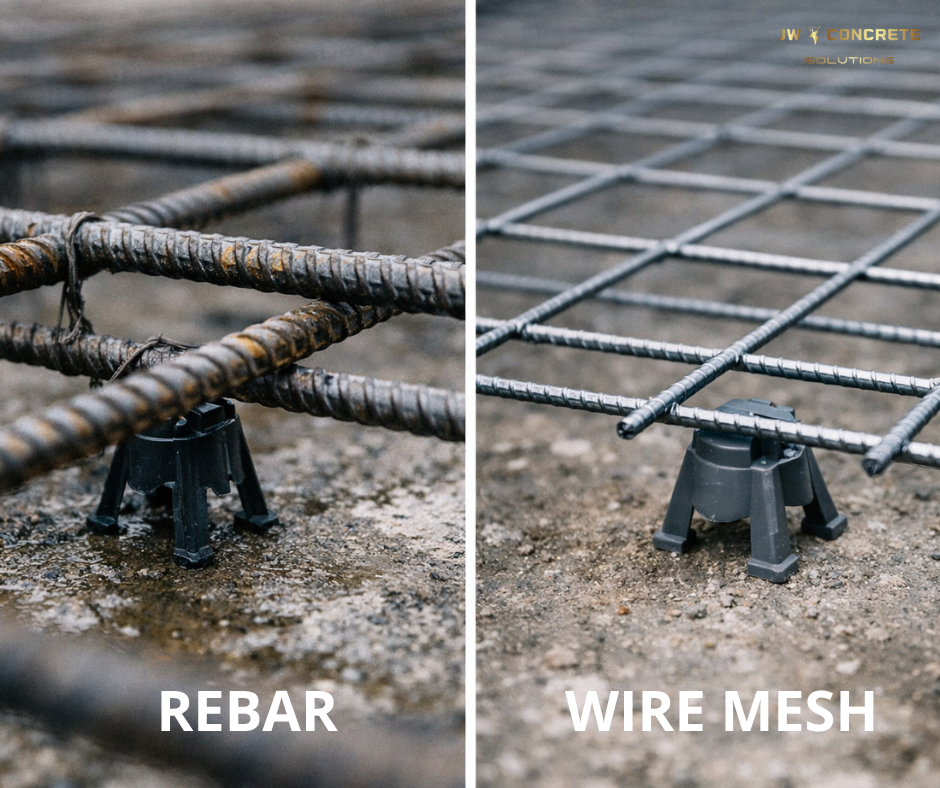
If you've been researching driveway replacement, you've probably come across this question: Is rebar or wire mesh better for preventing cracks?
It's a fair thing to ask. But the most honest answer isn't really about which material "wins." It's about understanding what reinforcement actually does—and what it can't do on its own.
What Reinforcement Is Actually Meant to Do
Concrete reinforcement—whether rebar or wire mesh—does a few specific things:
It controls movement. Concrete expands and contracts with temperature changes. In Minnesota, where temperatures swing 100+ degrees between seasons, that movement is significant. Reinforcement helps hold sections together as that happens.
It resists separation. When concrete does crack—and over time, most concrete does—reinforcement helps keep sections from pulling apart and creating an uneven, dangerous surface.
It improves long-term performance. A properly reinforced slab distributes load more evenly, which reduces the stress that leads to structural cracking under vehicle weight.
What reinforcement does not do is compensate for a poorly prepared base. No amount of rebar or mesh will hold up a slab that's sitting on unstable, poorly compacted ground. The two work together—the base handles the foundation, and the reinforcement handles the slab.
And no contractor worth hiring should promise you a crack-free driveway regardless of what's in it. What they can promise is a process built to minimize cracking and maximize longevity.
Rebar: Strong When Installed Correctly
Rebar—short for reinforcing bar—is a steel rod placed within the concrete slab before the pour. When it's installed right, it's one of the most effective ways to add tensile strength to concrete (concrete is strong under compression, but weak when it's being pulled or bent—rebar handles those forces).
The key phrase is installed correctly. Rebar needs to be:
Placed at the correct height within the slab. Rebar sitting on the ground surface isn't reinforcing anything—it needs to be elevated to roughly mid-depth in the slab, where it can do its job. At JW, we use chairs and supports to hold rebar at the right position before the pour, so it stays where it belongs.
Properly tied and laid out. A grid pattern with consistent spacing ensures the slab has uniform support across the entire surface, not just in some sections.
Part of a well-prepared base. Rebar on top of a weak, uncompacted subgrade is still rebar on top of a weak, uncompacted subgrade. The base has to be right first.
When those conditions are met, rebar significantly improves a driveway's ability to handle load, resist cracking, and hold together over time, through Minnesota winters included.
Wire Mesh: Common, But Often Misused
Wire mesh (also called welded wire fabric) is a grid of thin steel wire that is placed in the slab, similar in concept to rebar. It's widely used, and when installed correctly, it can provide crack control—particularly for lighter-use applications.
The problem isn't the material itself. It's how it's frequently installed in the field.
Wire mesh is often:
Laid flat on the ground before the pour. This puts it at the very bottom of the slab, where it does very little structural work. It needs to be elevated to the middle of the slab to be effective.
Pushed down during the pour. Workers walking on mesh during a pour—or the weight of concrete itself—can flatten it to the base. Once that happens, it's essentially decorative.
Left in place without verification. By the time the concrete is finished and sealed, there's no way to see whether the mesh ended up where it was supposed to be.
That's not a knock on every contractor who uses wire mesh. But it explains why homeowners sometimes hear "we use wire mesh reinforcement" and still end up with a driveway that cracks within a few years. The material wasn't the problem. The installation was.
What Actually Prevents Driveway Failure
Here's the straightforward version: reinforcement type matters less than the quality of everything else.
Base prep is the foundation—literally. At JW, every driveway starts with proper subgrade compaction and 4–6 inches of Class-5 rock. In soft or unstable soil, we excavate deeper and remove the weak material before the base goes in. You can pour the best concrete in the world over a bad base, and it will still fail. We've seen it.
Proper joint placement controls where cracking happens.
Concrete expands and contracts—you can't stop that. What you can do is cut control joints in the right places so any cracking that does occur happens where it's supposed to, not randomly across the surface.
Disciplined workmanship from start to finish. The right concrete mix (we use 5,000 PSI with 100% Class A aggregate—stronger than standard residential mixes), proper curing, and quality sealing all contribute to a driveway that holds up over time. Every step matters.
Reinforcement is part of that equation. But it's one part of a complete process—not a substitute for getting the other parts right.
How JW Approaches Reinforcement
We use rebar on our driveway installations. It's placed at the proper height, tied in a grid pattern, and installed over a correctly prepared base—not just laid on the ground and hoped for the best.
We're transparent about our process because we think homeowners deserve to understand what they're paying for. If you ask us what's going in your driveway and why, we'll tell you.
That's what "no shortcuts" means in practice.
Ready to Talk Through Your Driveway?
If you're trying to figure out the right approach for your project—reinforcement, thickness, base prep, or anything else—we're happy to walk you through it.
No pressure. Just a straight conversation about what your driveway actually needs.